Occupational Therapy: Focus, Feelings and Fun!
Posted on April 27, 2021,
Sioux Falls Children's Home
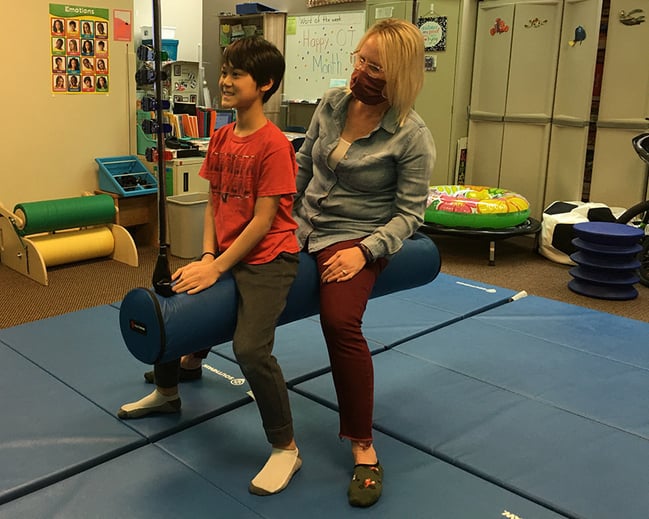
Along with being National Child Abuse Prevention Month, April is also National Occupational Therapy Month.
What do occupational therapists do? And what do they do at CHS? We visited with Occupational Therapist Jen Crisp-Griebel to learn more.
According to Jen, occupational therapy (OT) as a discipline helps people of all ages live fully by helping them promote health and prevent or better cope with injury, illness or disability.
OT methods use a holistic perspective, which focus on adapting the environment or task to fit the client. It’s an evidence-based practice rooted in science and the patient or client is an integral part of the team.
In a school setting, OT addresses:
- Fine motor skills
- Sensory processing
- Visual motor skills
- Self-regulation skills
- Self help skills
- Handwriting
OT at CHS
Jen works through the Loving School and sees children who are on an Individual Education Plan (IEP).
“I go into the preschool/kindergarten and third grade classroom once a week to work on fine motor skills and assist with teaching proper handwriting to the students,” she says.
“I work with all students in the class during these groups and provide suggestions to the classroom staff. I have also been able to eat with students during lunch who may need help using utensils, have difficulty with eating, or to help expand student’s variety of food intake.”
Jen consults with staff regarding students who may be struggling but are not on an IEP or eligible for services. She’s also available to provide trainings to other programs within CHS as needed.
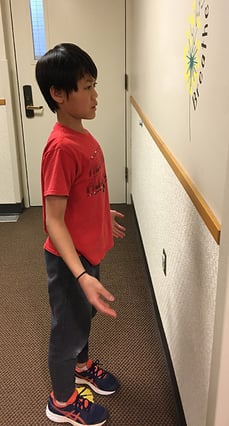
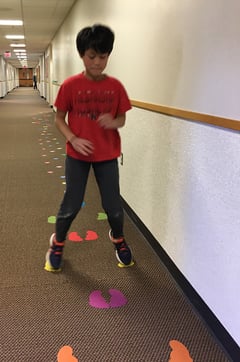
“Recently, I was able to place our new sensory pathway in the school,” she says. “This pathway was created to offer the kids a place to regulate and calm down using movement and deep pressure. I am training staff how to use the pathway as another tool to help kids achieve regulation.”
Often, Jen works in collaboration with other departments to meet the needs of the children. “For example, we had a child about a year ago that needed a bathroom evaluation in order to make using the shower/toilet safe,” she says. “I worked with nursing, the therapist, and residential staff to meet the needs of the student through adaptive equipment and training for both the staff and child.”
She also helps children whose handwriting is illegible. “I work with them on foundational hand skills, strengthening and eye hand coordination to improve their written output,” Jen says. “I may also provide pencil grippers for grasp, slant boards, modified paper, etc.”
Treatment is child-specific
Each child’s needs are different, and the treatments Jen provides are designed specifically for each child. Sometimes she needs to be creative to find a solution that works.
“For example, I am working with a child that is legally blind,” she says. With modified paper, high contrast paper, blocking excess print on the page, and using a slant board, the child is making nice progress with writing. This child hated OT upon arrival to CHS. Now the child is excited to come to therapy and work with me in OT.”
Another example is helping a student with tremors who spilled food and made a mess at lunchtime. “I got the child weighted utensils to use and worked with the child on strategies to use to decrease the spilling of food,” Jen says.
“So many of our kids have experienced significant trauma which has impacted their growth and the development of their sensory systems,” she says. “I work with these kids to increase their self-regulation skills and to give them an understanding of why they may respond the way they do.”
Jen mentions that one child she worked with really struggled with sensory processing and was resistive to many of the strategies she provided. “With creativity and building that therapeutic relationship, I helped the child find strategies to overcome some of the sensory challenges that they were facing,” she said.
“One day, the child asked for a hug (this child did not like touch and would pull away from it). While hugging me, the child said, ‘Thanks to you, I am now starting to trust adults again.’ I am very thankful that I get to be part of CHS and help kids to grow and heal.”