CHS's Partnership with RCPD
Posted on July 06, 2025,
Black Hills Children's Home
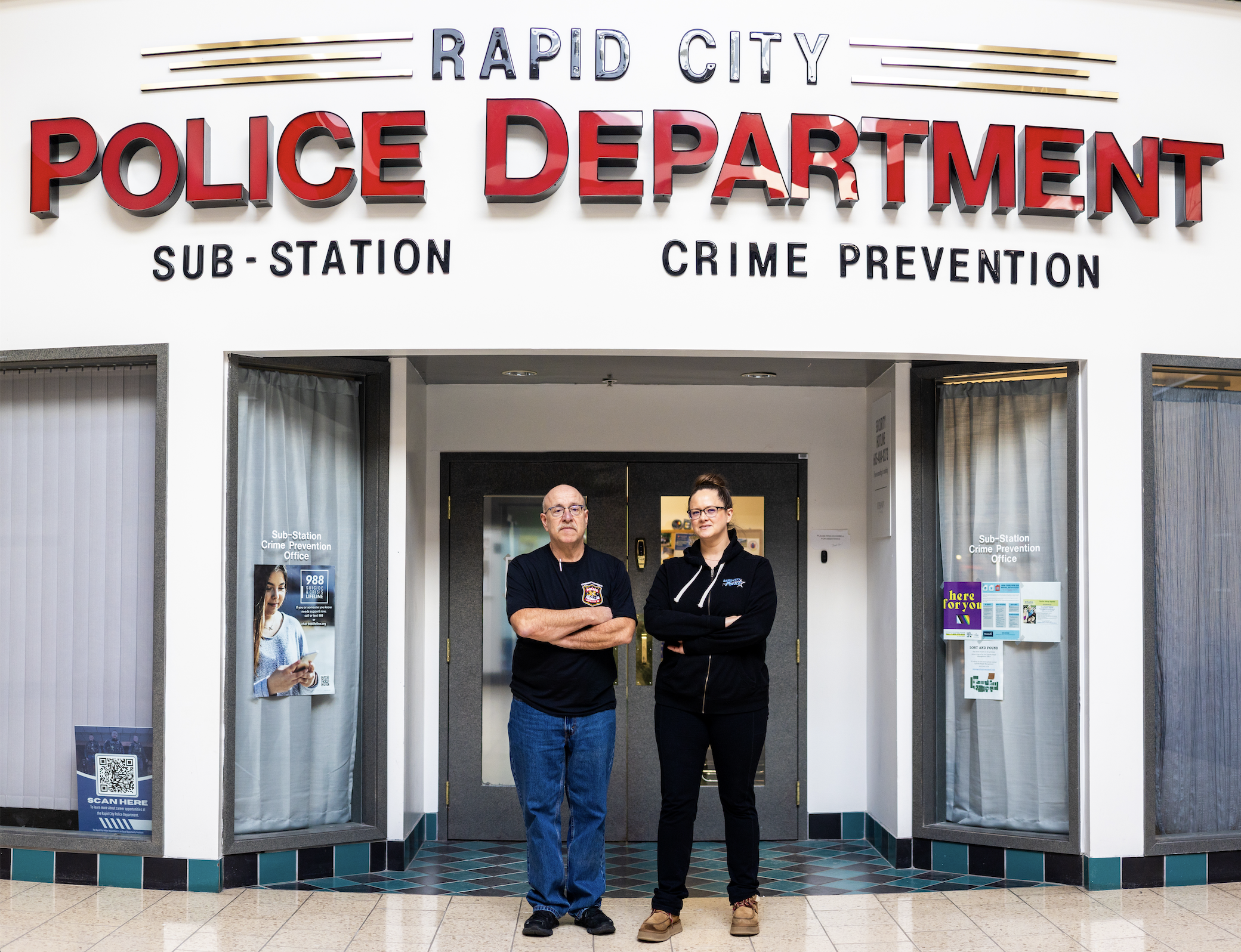
Children’s Home Society (CHS) Family Engagement Specialist Marty Krause spends a lot of time at the police station.
No, he’s not in trouble. Marty is embedded with the Rapid City Police Department (RCPD), providing case management services to people identified by police officers.
“Having Marty here gives us a layer of expertise that we don’t have on our team,” said Jamie Kirsch, RCPD Community Violence Interruption Program Manager. “Marty brings with him both the knowledge of casework and access to the tools and resources of Children’s Home Society.”
The goal of Jamie’s team is to reduce violence through prevention and intervention, which supports the police department’s goal of creating a safer community.
And it’s working. Jamie pointed out that in one neighborhood, which saw the city’s highest concentration of violent crime five years ago, their team has been able to reduce violent crime rates by more than 50% through intervention.
Why the police?
Because of the work they do, officers see first-hand which families need support. Using referrals from these officers, together with call-for-service and crime statistics, and other data, they can pinpoint specific individuals, families and neighborhoods that can benefit from outreach.
What does support look like? “It really depends on the family,” Marty said. “It can be as simple as getting to know them and providing links to different resources in the community, so they can get the services they need. In other cases, it can be very intensive, for example, helping a family fill out a residential care application for substance abuse treatment or psychiatric care and actually transporting the person to a facility.”
“Residential placement is always the last option,” he clarified. “We always want to keep families together, if at all possible.”
Teamwork opens doors, changes lives
When the police show up at someone’s home, people generally open the door—whereas if a case worker shows up, people may not even answer. They simply don’t have the authority that the police do.
Yet, people may not trust the police. “That’s where Marty comes in, as someone who isn’t an officer and can lend a helping hand,” Jamie said. Together, Marty and the police make a great team.
“The innovative component to this partnership is really that we’ve got law enforcement officers who are actively on patrol responding to calls for service, identifying families,” said Jamie. “It can be frustrating for officers because they don’t always have the tools to connect families to support, especially when they see the families struggling.”
Marty regularly goes to the Juvenile Services Center to work with incarcerated youth to help them transition back to the community. He also visits an inpatient treatment facility for youth to give presentations to patients.
“We're working with individuals and families one-on-one to stabilize them, to connect them to the right supports, to prevent an escalation into the criminal justice system, and to stop that cycle of violence from one generation to the next,” Jamie said.
Innovative program benefits community
Rapid City is one of a select handful of communities with law enforcement that can provide this type of support.
“As far as I know, we are among a very small group of law enforcement agencies nationwide utilizing these types of strategies and have these types of dedicated teams providing co-response support,” Jamie says.
According to Jamie, the results of the program prove that the approach works. “We can see it tangibly in the numbers. For us, it means that entire neighborhoods are seeing a reduction in the amount of violence they're exposed to on a daily basis,” she said. “To go from what was once 60 violence-related calls for service in 2022 to just 30 violent calls for service in 2024 is a significant drop.”
Marty agreed. “We're trying to make the community a better place for everybody to live in, and have healthier relationships, healthier families, healthier children, grandparents, the whole family unit, and a healthier community.”
Answering a call for help
Marty is working with a family in which three children live with a grandparent. The oldest child, age 11, was drinking a fifth of vodka every night and smoking marijuana. “She had basically not attended any school in two years,” Marty said. “
“We were able to go in and work with that family,” he explained, “We helped get that child into substance abuse treatment to make sure she is safe.”
“Now, we are working with the two other children, who have some difficult behavioral health challenges as well,” Marty added. “Due to the partnership between the RCPD and CHS, we can utilize the staff from both of those entities to make all that happen.”
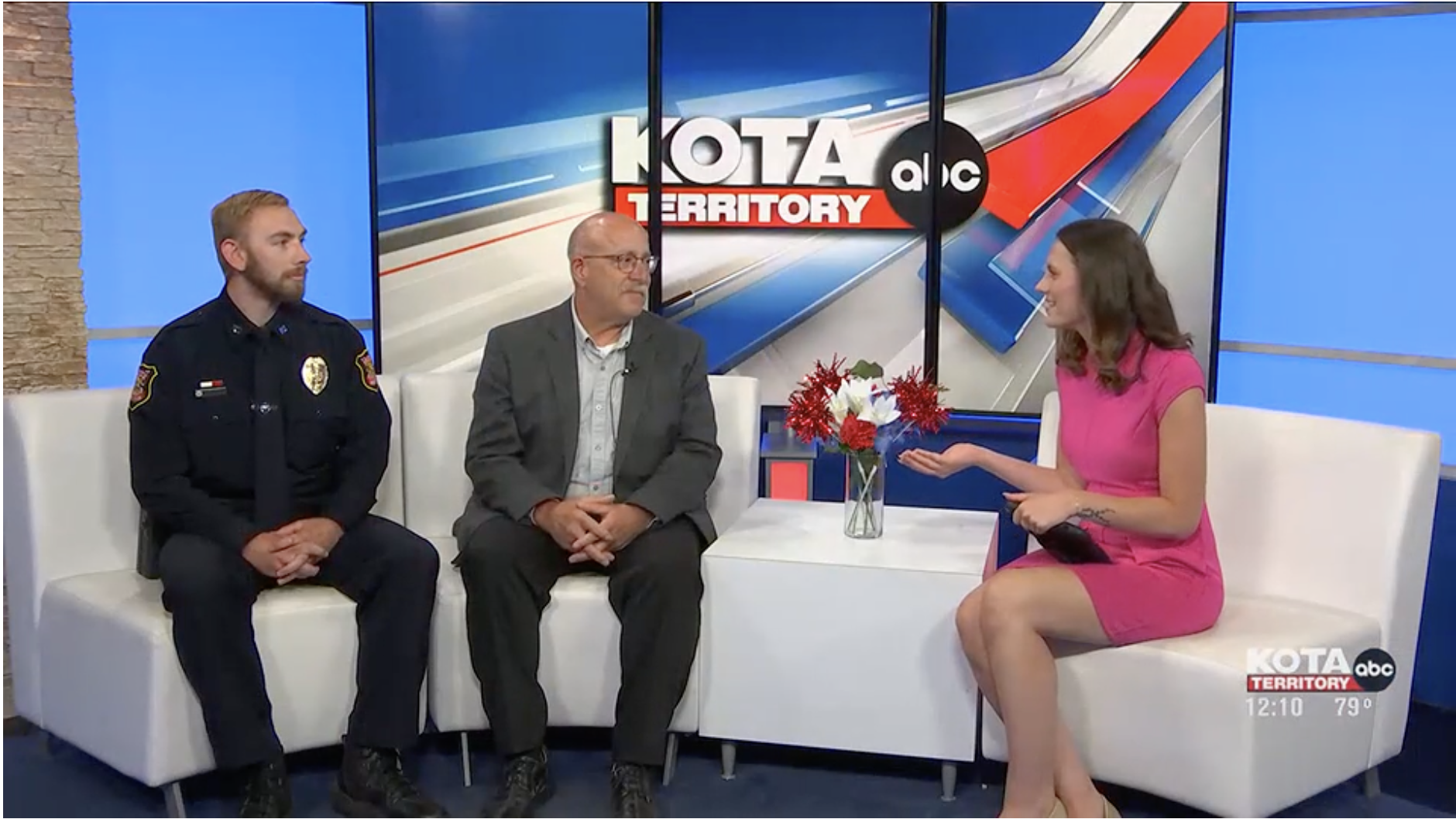
Marty recently shared more about the partnership during an interview on KOTA. Watch the video here.